Campus placements are an important part of every college's journey. But placement success is not created during the few weeks when companies arrive on campus.
It starts much earlier—with how students learn, practice, build skills, and prepare for their careers.
Today, employers look beyond academic scores. They evaluate technical skills, communication, problem-solving, resumes, confidence, projects, and interview performance.
This raises an important question:
Are colleges preparing students only for placement drives—or for successful careers?
The answer lies in building a continuous campus-to-career ecosystem.
The Problem With Last-Minute Preparation
Many students begin serious placement preparation only when companies start visiting their campus.
By then, they may have limited time to improve their:
Technical skills
Communication
Resume
Interview confidence
Aptitude
Problem-solving abilities
A short training program cannot always address years of skill gaps.
Instead of asking, "How can we train students before placements?"
Colleges should ask:
"How can career preparation become part of the student journey?"
---
Placement Readiness Is More Than a Resume
A career-ready student needs more than good academic scores.
They need:
Technical Skills — The ability to apply knowledge to real problems.
Communication — The confidence to explain ideas clearly.
Interview Skills — The ability to handle technical and HR interviews.
Professional Branding — A strong resume, portfolio, and professional profile.
Industry Awareness — An understanding of roles, companies, and employer expectations.
A strong placement ecosystem should develop all of these areas.
---
Start Career Preparation Early
Placement preparation shouldn't begin in the final semester.
A better approach is:
First Year → Explore
Understand career paths, industries, and opportunities.
Second Year → Build
Develop technical skills, projects, communication, and problem-solving.
Third Year → Practice
Work on coding, aptitude, resumes, assessments, and mock interviews.
Final Year → Perform
Focus on recruitment drives, company-specific preparation, and interviews.
The placement drive then becomes the result of preparation, not the beginning of it.
---
How AI Can Help Students
Artificial intelligence is creating new possibilities for personalized career preparation.
Every student has different strengths and weaknesses.
One may need technical practice.
Another may need interview confidence.
Someone else may need help improving their resume.
AI-powered tools can support students with:
Resume improvement
Mock interviews
Personalized feedback
Skill practice
Career exploration
Interview preparation
AI doesn't replace faculty or mentors.
It gives them better tools to support more students.
---
Practice Before the Real Interview
Knowing the answer isn't always enough.
Students also need to know how to communicate under pressure.
Regular mock interviews can help students practice:
Self-introduction
Technical questions
Project explanations
HR questions
Behavioral questions
Follow-up questions
AI-powered mock interviews provide students with a safe environment to practice, receive feedback, and improve.
Practice turns uncertainty into confidence.
---
Placement Teams Need Smarter Tools Too
Students aren't the only ones who need support.
Placement teams manage:
Student registrations
Eligibility
Company requirements
Recruitment drives
Interview schedules
Attendance
Selection status
Placement reports
Managing everything through spreadsheets, emails, and multiple communication channels can become challenging.
A centralized placement platform can help bring these activities together and give placement teams better visibility.
---
Data Should Drive Placement Decisions
Placement data shouldn't only be used to calculate the final placement percentage.
It can help colleges understand:
Student participation
Department performance
Recruitment outcomes
Interview performance
Skill gaps
Recruiter engagement
Placement trends
Instead of asking:
"How many students were placed?"
institutions can ask:
"What can we improve to help more students succeed?"
That is where placement analytics becomes valuable.
---
The LeetCampus Approach
LeetCampus is built around one simple idea:
Student preparation and placement management should work together.
Students need tools to learn, practice, build their professional profiles, and prepare for opportunities.
Placement teams need tools to manage recruitment and student activity.
Institutions need insights into their placement ecosystem.
Recruiters need access to relevant, prepared talent.
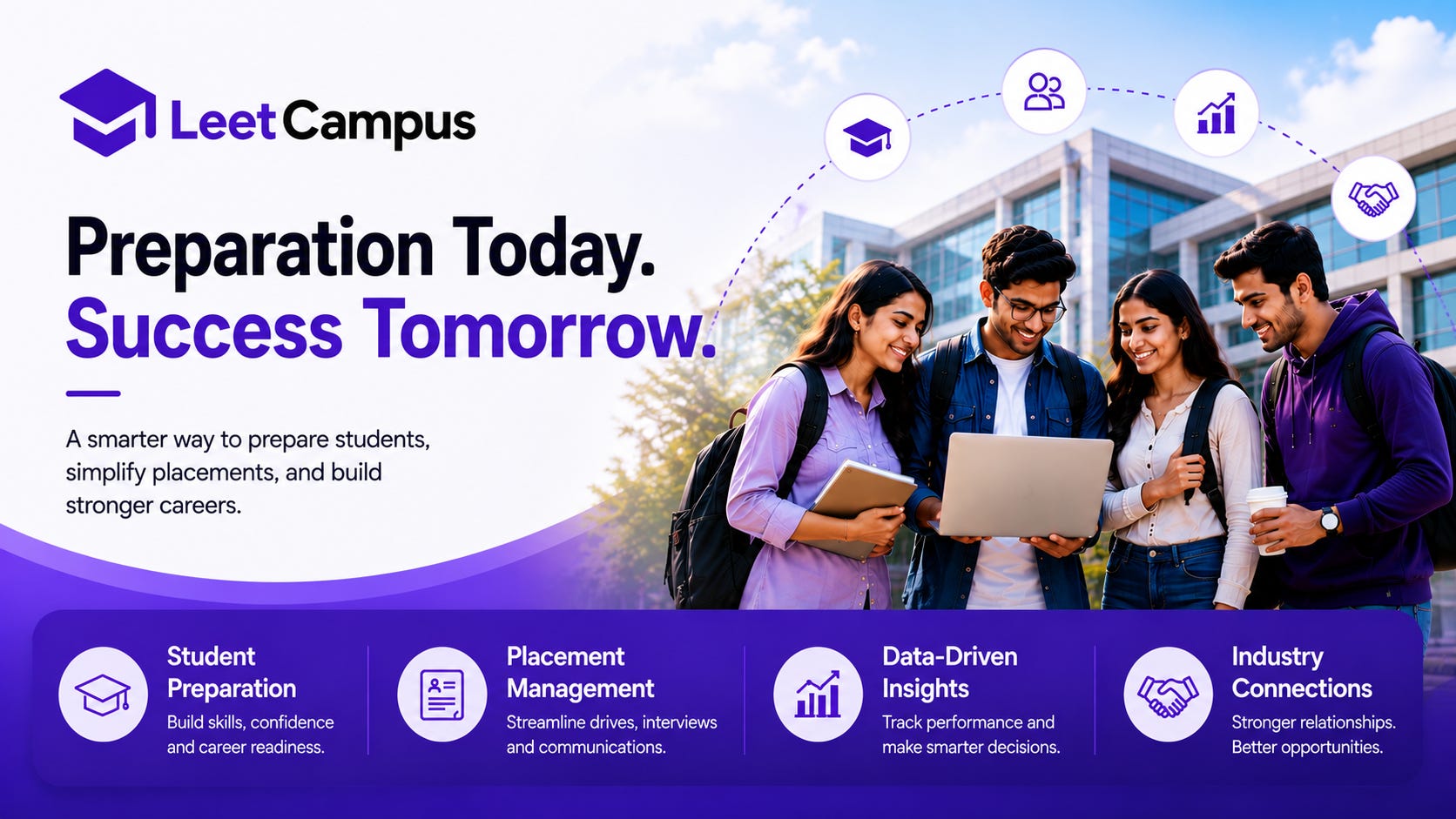
LeetCampus brings these elements closer together through a campus-to-career ecosystem covering student preparation, AI-powered career tools, placement management, recruitment, and analytics.
---
Rethinking Placement Success
A successful placement program shouldn't be measured only by the number of offers.
A stronger definition is:
Better Preparation + Better Opportunities + Better Matching = Better Outcomes
The goal isn't simply to help students clear one recruitment test.
It's to prepare them for the careers that follow.
---
The Future of Campus Placements
The placement cell of the future will operate throughout the academic year—not only during recruitment season.
Students will continuously build skills.
Faculty will support development.
Placement teams will track readiness.
Recruiters will connect with relevant talent.
AI will provide personalized support.
Analytics will identify gaps.
This creates a true career development ecosystem.
---
Conclusion
The strongest placement strategy isn't the one that starts when the recruiter arrives.
It's the one that starts when the student arrives.
By combining continuous preparation, AI-powered tools, placement management, analytics, and industry connections, colleges can build students who are better prepared for the real world.
LeetCampus is helping institutions move toward this campus-to-career model—connecting learning, preparation, recruitment, and career opportunities in one ecosystem.
Learn. Build. Grow. Succeed.
Explore LeetCampus: