A college degree opens the door to a career—but it doesn't automatically prepare a student to walk through it.
Today, employers look beyond academic scores. They evaluate technical skills, communication, problem-solving ability, resumes, interview performance, adaptability, and practical knowledge.
This creates a growing responsibility for colleges: How can institutions ensure that students are not just academically qualified, but genuinely career-ready?
The answer lies in building a stronger connection between classroom learning, skill development, career preparation, and recruitment.
Technology and artificial intelligence are making this possible.
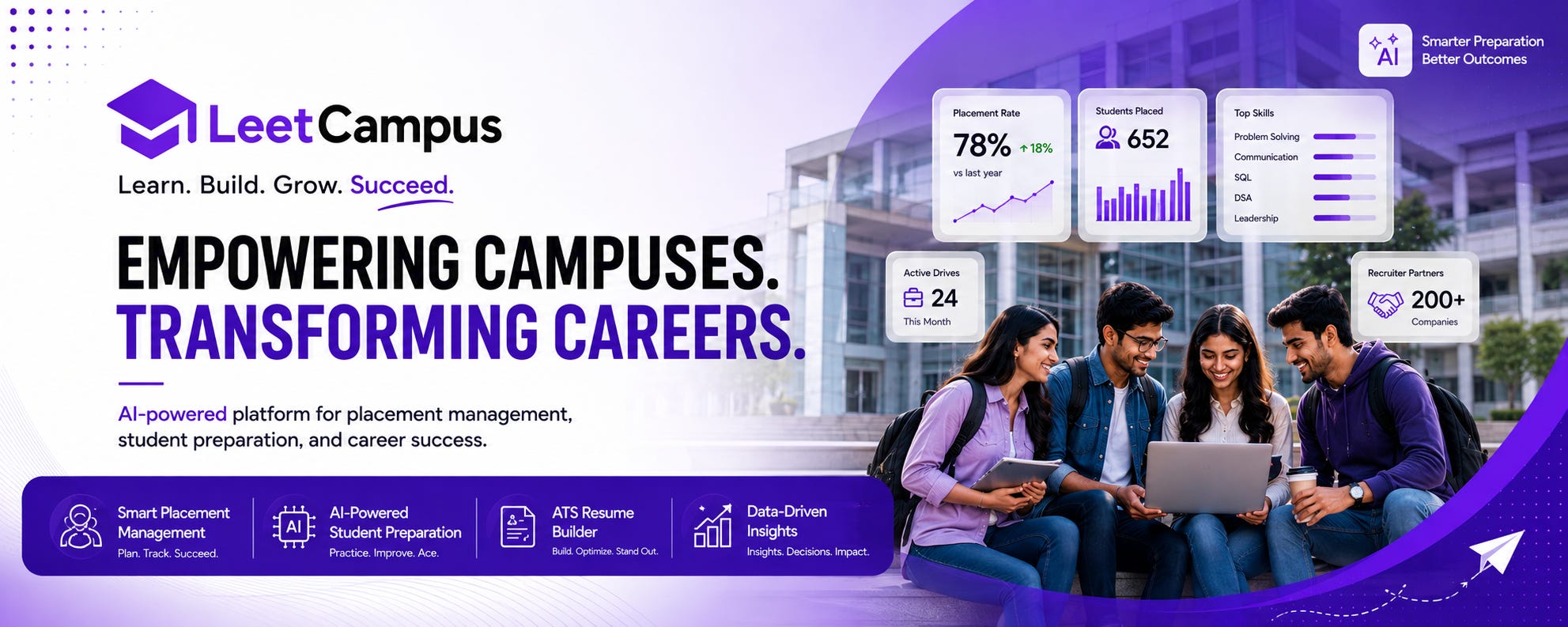
Platforms such as LeetCampus are helping institutions bring these different stages of the student journey together through an integrated campus-to-career ecosystem.
The Growing Gap Between Education and Employability
Students spend years developing academic knowledge. However, the recruitment process often measures a completely different set of capabilities.
A recruiter may ask a student to:
Solve a technical problem
Explain a project
Communicate clearly
Handle an HR interview
Build an effective resume
Demonstrate practical skills
Adapt to unfamiliar questions
A student can perform well academically and still struggle with these situations.
This is commonly referred to as the employability gap—the difference between what students learn academically and what employers expect during recruitment.
For colleges, closing this gap needs to become a continuous process rather than something that begins a few weeks before placement season.
What Does It Mean to Be Career-Ready?
A career-ready student is not simply someone who has a good CGPA.
Career readiness involves multiple dimensions:
1. Technical Skills
Students need practical knowledge that aligns with the roles they want to pursue.
For technology-focused careers, this can include:
Programming
Data structures and algorithms
Database concepts
Web technologies
Data analysis
Problem-solving
2. Communication Skills
Students need to confidently communicate their ideas, projects, achievements, and experiences.
3. Interview Skills
Knowing an answer isn't enough. Students need to know how to approach and communicate an answer during an interview.
4. Professional Branding
A student's resume, LinkedIn profile, portfolio, and projects contribute to their professional identity.
5. Industry Awareness
Students should understand what companies are hiring for, what skills different roles require, and how recruitment processes work.
A modern college placement strategy should address all five.
Why Placement Preparation Should Start Earlier
One of the biggest mistakes institutions can make is treating placement preparation as a final-year activity.
By the time students enter their final year, there may be limited time to identify and address skill gaps.
A better approach is to introduce career readiness progressively.
First Year
Focus on:
Career awareness
Communication
Digital skills
Exploring career paths
Second Year
Introduce:
Technical skill development
Projects
Aptitude preparation
Industry exposure
Third Year
Focus on:
Coding practice
Resume development
Mock interviews
Company-specific preparation
Final Year
Students can concentrate on:
Placement drives
Interview preparation
Recruiter interactions
Job applications
This creates a continuous campus-to-career journey instead of a last-minute placement rush.
How AI Can Improve Student Preparation
Artificial intelligence is changing how students learn and prepare for careers.
Instead of providing the same preparation material to every student, AI can help create more personalized experiences.
For example, a student struggling with technical interviews could receive targeted practice recommendations.
Another student may need help improving their resume.
Someone else may need additional interview practice.
AI-powered tools can support these different needs at scale.
LeetCampus provides an ecosystem of AI-powered career and learning tools designed around this journey, including resume building, interview preparation, personalized learning, and career development.
AI-Powered Resume Building
The resume is often the student's first interaction with a recruiter.
A poorly structured resume can make it difficult for recruiters to understand a candidate's skills and achievements.
LeetCV helps students create professional, ATS-optimized resumes using AI-powered content suggestions and industry-focused templates. It also provides tools for cover letters, resume reviews, portfolios, and LinkedIn imports.
This allows students to focus on communicating their actual strengths rather than struggling with resume formatting.
AI Mock Interviews: Practice Before the Real Interview
Interview confidence is developed through practice.
Students who have never experienced an interview environment may struggle with:
Answering unexpected questions
Explaining projects
Communicating technical concepts
Handling HR questions
Managing interview pressure
LeetPrep provides AI mock interviews, instant feedback, performance tracking, interview guides, and structured preparation resources.
Repeated practice gives students the opportunity to identify weaknesses before they encounter the actual recruiter.
Company-Specific Interview Preparation
Generic interview preparation isn't always enough.
Different companies and roles can focus on different technical concepts, interview formats, and evaluation methods.
LeetCampus's LeetResearch provides company- and role-oriented interview preparation, including previous interview questions, round breakdowns, key topics, and preparation guidance.
This allows students to move from:
"How do I prepare for an interview?"
to:
"How should I prepare for this specific role and company?"
That difference can make preparation significantly more focused.
Placement Officers Need Better Visibility Too
Student preparation is only one side of the equation.
Placement officers manage complex operational responsibilities, including:
Student eligibility
Recruitment drives
Interview schedules
Attendance
Recruiter coordination
Placement records
Reports
Managing these activities through spreadsheets and disconnected communication channels can become difficult as student populations grow.
LeetCampus's placement ecosystem provides tools for recruitment management, student tracking, scheduling, analytics, and institutional reporting.
This gives placement teams greater visibility into the recruitment journey.
Data Can Help Colleges Make Better Placement Decisions
Placement numbers tell only part of the story.
Colleges can gain deeper insights by analyzing:
Department-wise placement performance
Student participation
Recruitment drive performance
Interview conversion
Company-wise outcomes
Student preparation levels
LeetCampus provides analytics across college, department, and student levels to support data-driven placement decisions.
Instead of asking:
"How many students were placed?"
institutions can begin asking:
"Why did some students perform better, and how can we help more students reach the same level?"
That's where data becomes valuable.
Building a Stronger College Placement Ecosystem
The future of campus placements isn't about one tool.
It is about connecting the entire ecosystem.
A strong placement ecosystem brings together:
Students → Faculty → Placement Officers → Recruiters → Alumni → Industry
Students develop skills.
Faculty provide academic and mentoring support.
Placement officers coordinate opportunities.
Recruiters identify talent.
Alumni provide industry exposure and mentorship.
Technology connects these stakeholders.
LeetCampus brings together multiple components of this ecosystem, including campus management, recruitment, career development, preparation, networking, and AI-powered learning.
What Colleges Can Do Today
Institutions don't need to completely redesign their placement process overnight.
They can begin with a few practical steps:
1. Start Career Preparation Early
Introduce employability programs before the final year.
2. Measure Skills, Not Just Marks
Track technical, communication, aptitude, and interview readiness.
3. Encourage Continuous Practice
Give students regular opportunities for coding, assessments, and interviews.
4. Personalize Preparation
Use AI and analytics to identify individual skill gaps.
5. Digitize Placement Operations
Reduce dependency on spreadsheets and manual processes.
6. Build Industry Connections
Give students more opportunities to interact with recruiters and professionals.
7. Measure Outcomes
Use placement data to continuously improve institutional strategies.
The Future Is Campus to Career
The role of a college is evolving.
Institutions are no longer evaluated only by academic infrastructure. Students and parents increasingly look at career outcomes, industry exposure, employability, and placement opportunities.
This means colleges need to think beyond "education to graduation."
The new journey is:
Learn → Practice → Build → Prepare → Connect → Get Hired
Technology can make this journey more structured, measurable, and personalized.
How LeetCampus Helps
LeetCampus is designed around the idea of creating an integrated campus-to-career ecosystem.
Its platform brings together solutions for:
Campus management
Placement management
AI-powered resume creation
Interview preparation
Coding practice
AI tutoring
Student networking
Recruitment
Analytics
Industry connections
The goal isn't simply to help students get through a placement drive.
It is to help institutions create students who are better prepared for the world of work.
Conclusion
The future of higher education belongs to institutions that can successfully connect learning with opportunity.
Academic knowledge remains essential—but today's students also need practical skills, confidence, communication ability, professional branding, interview experience, and industry awareness.
Colleges that build these capabilities early can create a stronger and more sustainable placement ecosystem.
With AI-powered tools and an integrated campus-to-career approach, platforms like LeetCampus can help institutions move from simply managing placements to building career-ready students.